Showing posts with label Birding. Show all posts

Mar 8, 2015

The Eastern Bluebird and Nest Boxes

Well we still have 3 to 4 feet of snow still on the ground here in Northeast Connecticut but the day time temps are finally starting to climb.  According to the calendar spring is just 2 weeks away but I think we might be battling snow and ice for a few weeks after that.  But there is hope, especially when I get new visitors to my backyard like the Eastern Bluebird.

Taken March 2015 at my feeder


The male Eastern Bluebird is easily identifiable by their brilliant royal blue color and rust colored throat and neck while females will be more gray on the back with blue in the wings.  Definitely colors that catch your eye when bird watching. Bluebirds will visit your feeders and enjoy fruit, mealworms, peanut hearts and even suet.  They are truly a treat when they visit.


Eastern Bluebirds will start their nesting in early March and it is important to get your Bluebird nesting boxes built and installed early in the nesting season if you want to keep them around.  Nestwatch.org has a downloadable set of Bluebird nesting box plans that makes this project a snap.

I hope you are lucky enough to have Bluebirds visit your backyard this year.


Jan 17, 2014

Sharing my Christmas Present with my Followers


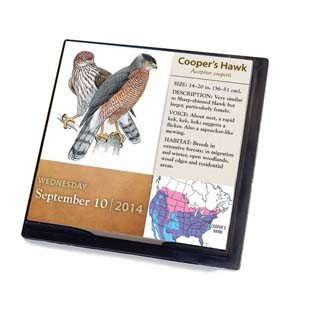
I must have been a good boy last year because Santa left me a Peterson Guide to Birds of North America 2014 Daily Desktop calendar.  Every day I get to learn about a new bird and refresh myself on some I already know. 


Purchase on Amazon
Along with some very colorful images of the birds there is a description of the bird, details about the bird's size, the habitat it lives in and even the sounds it makes.  There is also a range map image in the lower right corner.


So in keeping with my Backyard Birds theme lately, I will be sharing the daily bird with you and all you have to do is follow along on our PassinthruOutdoors Facebook page or my @PTOutdoors Twitter feed.

If you want to learn more about a specific bird I suggest you stop by the Cornell - All about birds home page and use their Browse for a bird by name and shape ID section.

Enjoy!

Jan 7, 2014

Backyard Bird Identification Basics

It was just a normal morning with me eating breakfast and sipping coffee while enjoying the activity at my bird feeders when I noticed a new feathered visitor jump on the suet feeder.  I quickly grabbed my camera and snapped a couple of pictures and then opened up the laptop and went about figuring our what it was. I knew it was a woodpecker and looked similar in size, shape and even some markings to a Downy woodpecker that visits often.  I was able to find what I thought it was by using an online bird guide, but I was still a little unsure.  The next morning it visited again and this time I could hear what resembled like a cat meow.   Using this information I went back to my online bird guide and verified that it was a yellow-bellied Sapsucker.  Of course I still confirmed my sighting on a few Facebook pages.

Yellow-Bellied Sapsucker January 2014


It can be a real challenge when trying to identify a new visitor to my feeder and I am no expert.  Having a camera handy is very helpful but if you don't have one there are a few things to make note of quickly before your friend disapears.

White-breasted Nuthatch (left) - Red-bellied Woodpecker (middle) - Dark-eyed Junco (right)


Size and Shape

Many of our feathered friends can be very colorful and we can get caught up in those colors during their visit but the most important piece of information in making a good id is it's size and shape.  Also becoming familiar with bird silhouettes will help as well.  Gauging the size can be a challenge with nothing to make a real comparison to, like another bird, but practice this and make sure to pay particular attention to things like the bill, wings and tail, not just their shape but size relationship to the rest of the body.  Using the silhouette of the bird will help you narrow down your search in your field guide.

Color Pattern


It's easy to get caught up with the amazing colors of some birds, but for ID purposes concentrate on the overall colors, light and dark, instead of the exact details of each feather.  Also how bold or faint the color is.  Many birds can have very similar markings , but one bird might have bolder colors then the other.   When observing female birds that are not as colorful as the males, it becomes an even bigger challenge and takes practice.

Behavior

How a bird acts, sits, moves, flies can be very helpful in narrowing down a list of choices.  You must take your time and watch them.  I learn a lot about bird behavior when I am trying to take their pictures.  It is almost impossible to chase some birds around in your viewfinder as they almost never sit still long enough, but by watching them I learn what each one does before coming to my feeder and this allows me to setup a ambush spot to take their picture even if they only stop on a particular branch for a second or two.  Pay attention to a birds posture when sitting as there will be some keys here to help in your ID.  Also how a bird feeds is another clue. 


Habitat

Where a bird lives and at what times of the year it is present will really help you narrow down your ID when you have a couple of options.  Knowing what birds might be in your area is a good start.

Field Marks

Field marks are the details such as distinctive stripes, spots, colors and patterns that offer up additional clues.  You will also want to learn a little bit about the anatomy of a bird.  Field markings on the head, around the eye, on the wings, tail or belly are all good places to find clues.

Songs and Calls

I enjoy listening to the birds around my feeder, even during the warmer months when they start just below my bedroom window long before I am ready to get up.   If you can see a bird while it is singing that is great.  Sometimes you will hear them before you see them.  Some sounds can sound like words as well.


Online resources and Field Guides

Below are some links to some online resources, smartphone apps and field guides that can be useful in helping you with your bird ID.

The Cornell Lab of Ornithology - By far my favorite birding resource.  Their site is full of information about birds from online bird guide where you can browse the database by name and shape or get great tips on how to attract birds to your backyard.  There is also plenty of links on ways to get involved and links to live bird cams.

eBird  - is a real time online checklist program that allows you to record your sightings, keep track of your checklist and share your sightings with other birders in the community and all this helps contribute to science and conservation.

Peterson Guides - Hard copy field guides as well as apps for your smartphone or tablet and their apps and database are connected with eBird to give you the latest information of sightings for your area.

Now you have some basic information to start your birding activities.  Good luck!

Jan 2, 2014

Backyard Birds Photos December 2013

Found some time to take some photos of my feathered friends that visited my bird feeders in December.  Enjoy them!

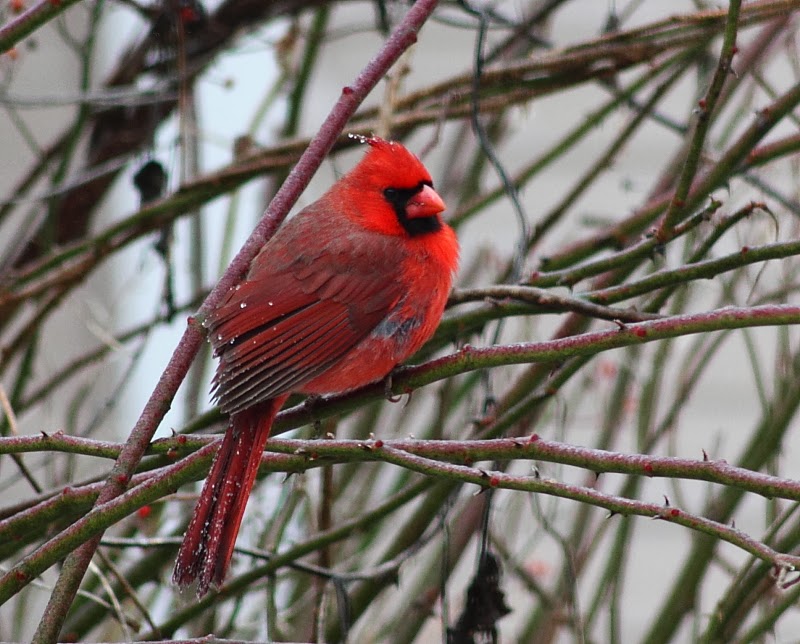
Mr. and Mrs Norther Cardinal


Mr and Mrs. Downy Woodpecker


Mr. and Mrs. House Finch


Red-bellied Woodpecker & White-breasted Nuthatch


Feb 12, 2013

Great Backyard Bird Count 2013 Feb 15 - 18


It's that time of the year to get outdoors and count the birds as the Great Backyard Bird Count takes place this weekend for 4 days starting Friday Feb 15th and ending on Monday Feb. 18th.


What is the GBBC?

The Great Backyard Bird Count is an annual 4-day event that engages bird watchers from all over the world and of all ages in counting birds to create a real-time snapshot of where the birds are.

Everyone is welcome--from beginning bird watchers to experts. It takes as little as 15 minutes on one day, or you can count for as long as you like each day of the event. It’s free, fun, and easy—and it helps the birds.
Participants tally the number of individual birds of each species they see during their count period. They enter these numbers on the GBBC website.

Why count birds?

Scientists and bird enthusiasts can learn a lot by knowing where the birds are. Bird populations are dynamic; they are constantly in flux. No single scientist or team of scientists could hope to document and understand the complex distribution and movements of so many species in such a short time.

Scientists use the GBBC information, along with observations from other citizen-science projects, such as the Christmas Bird Count, Project FeederWatch, and eBird, to get the “big picture” about what is happening to bird populations. The longer these data are collected, the more meaningful they become in helping scientists investigate far-reaching questions

How to Participate?

Visit the GBBC website to learn more about the GBBC and how you can participate in this years Backyard Bird Count.

The GBBC offers up an opportunity to get the family together enjoy mother nature, even if you still ahve 2 feet of snow like we do in Connecticut. Count birds while sitting by your window watching the feeders or get outside and explore your local forest and parks. There are also photo contests, local events and plenty to learn by particpating.

You can read about our results from the 2012 count here: http://passinthruoutdoors.blogspot.com/2012/02/backyard-bird-count-results.html


Oct 18, 2012

So Where Did That Canada Goose Really Come From?

For those of us who hunt waterfowl the fall migration is the holy grail and something we look forward to every year.  Migration means large numbers of ducks and geese leaving their northern haunts and heading south for the winter, but you never really know where that duck or goose was unless you are lucky enough to harvest a bird that has been banded.  For us waterfowlers, a banded bird is truly a special gift and one that causes a bunch of discussion in the blind until that lucky hunter can get home and report the band to find out where this bird was from. 

Bubba's Banded Goose

Last week was the Goose opener here in Connecticut and it found yours truly and the normal group of characters headed to the dairy farm for what we had hope would be a successful  hunt with a limit of geese to be turned into a fresh batch of goobasa, goose keilbasa that is. Little did we know that this hunt would turn special with one shot at a goose trying to get away, but it surely did.

It started out as a normal hunt on the farm, with an early morning gathering, setting out the decoy spread, hunkering down in the blind and waiting for the geese to start moving.  We had to deal with the fog and low visibility and birds that don't make much noise in the fog, but the second group of geese heading our way liked what we had to offer and committed to the spread.  Just as the first couple of geese touched down, the caller called take em, the door to the blind fell and there were 15 geese to pick from. We dropped 3 right away and one a little farther out to eh right and Bubba took a final shot at one trying to get out of dodge just about to the safe zone but he dropped it.  Once the shooting is done, the Chinese fire drill starts where a couple of us exit the blind and gather up the downed geese.  I had the pleasure of being set out for the long retrieve and as I approached the down bird, I got my first glance of the jewelry this goose was wearing - A dulled yellow neck collar.  Now I know no one say the collar or the goose would have been dumped a whole lot quicker, so I gathered up the goose making sure my hand covered the collar completely and the feet facing away from everyone.  As I approached the blind the guys were stammering about what a good shot that was and I asked who made the shot, hoping multiple people would claim it, but everyone pointed to Bubba and so I spun the goose around so everyone could see the yellow neck collar and you would have thought everyone was watching the winning run score in game 7 of the world series.  No one really payed much attention to the metal leg band at the time, so we put the goose in the blind and got set back up for the next flock.

We worked the next flock that came in and brok three geese away and they dumped into the decoys and all three stayed and joined the previous 5.  The next flock allowed us to break off just two birds which was exactly what was needed to finish off our 5 man limit, so the pressure was on for Busch Pilot and Chuck to drop the last two and it took an extra shot or three but they did their job and the mission was complete and it was just 7:50am.  A 5 man limit of geese on the 2012 Connecticut goose opener, man you could could smell the goobasa cooking in the smoker.

2012 opening day goose limit


As we were picking up and trying to get packed up and out of the field so as not to spook any geese coming in for a morning meal, one of the guys was looking over the banded goose and took the first look at the leg band and it read - Zoologisk Muesuem  Coppenhagen, Denmark.  This was obviously not the typical federal leg band that we have seen before and the excitement level grew and we could not wait to get back to the house to see what we could find out about this band.  After reviewing the federal band reporting sight and finding nothing, we did a quick google search and found a report from a New Jersey hunter that harvested a goose tagged in the same manner.  There were some links in the replies to his post asking for help and one pointed us to the European Union for Bird Ringing (http://www.euring.org/).   Where after review of their website we found a link to the European Colour-Ring Birding website (http://www.cr-birding.org/) which had links to search the ringing projects where we found two that matched the method and species of Bubba's goose.  There were two projects, one in Russia and one in Greenland.  Both projects listed contact information for the project coordinators so we sent off a couple of emails and by that evening Bubba had received a reply confirming that the banded goose he harvested was from the Greenland project.

Bubba with his West Greenland Banded Goose


The information received from the coordinator confirmed that Bubba's goose had been captured and banded as an adult female on July 23, 2008 on lake "F" in an area known as Isunngua (few of the lakes have names in this area) which was just north of the airport at Kangerlussuaq in West Greenland.  This goose had been reported as being sighted in Connecticut in November of 2008 and September of 2009 as well as back in West Greenland in 2009, 2010 and most recently in July of 2012.  Geese from this project have been reported from Canada to as far south as Virgina and as far west as Ohio. You can read more about this banding project and some of the geese from this project at:  http://greenland2011.wikispaces.com/Recoveries+and+resightings.   

Now we really are not sure how far this goose actually flew because we don't really know what flight path it took and what stops it made along the way from West Greenland this year, but the best I could come up with is approximately 2000 miles as the crow goose flies.   We may not know where the other 4 geese that were harvested in out of the flock with GNI, but you would have to think that she wasn't alone in this flock.

Remember to report all sightings and harvests of banded birds and a good place to start is the Federal band reporting website at: http://www.pwrc.usgs.gov/BBL/bblretrv/


Feb 23, 2012

Backyard Bird Count Results

Well my family and I participated in the 2012 Great Backyard Bird Count this past weekend where we observed and counted birds in our yard and at local parks.  We did out best to identify every bird we observed and recorded them and submitted our numbers through the GBBC website.

Our friend Whitey - Dark-eyed Junco Feb 2012
 As of 4pm February 22 the GBBC list the results of the submitted counts as follows:

Statistics from 2012
Total Checklists Submitted:
85,191
Total Species Observed:
604
Total Individual Birds Counted:
12,088,058


There are many different counting methods depending on where and how you are counting.  For example when counting at a feeder you only report the largest number of a species seen at the same time, not the total number seen during that period.  Now if you are out on a hike, then you can count the total number seen on that hike.  These methods are meant to reduce the number of duplicate birds counted.   Pretty staggering numbers for sure.

Downy Woodpecker Feb 2012

We observed the following species in our backyard at our feeders:
Northern Cardinal
Dark-eyed Junco
Carolina Wren
White-breasted Nuthatch
Black Capped Chicakdee
Tufted Titmouse
Downy Woodpecker
Blue Jay
House Sparrow
Song Sparrow
White-throated sparrow

There were a total 23 species recorded representing a total of 214 birds counted in my town alone.  There were 148 specifies recorded representing a total of 103,899 birds counted in the state of Connecticut as of 4pm February 22.

A Pair of Tufted Titmice obviously in a disagreement - Feb 2012

I try to sit and enjoy the birds in my yard on a regular basis but by participating in this counting event forced us to do it for multiple days in a row and we learned plenty, had plenty of laughs and shared the beauty that mother nature provides with each other. Definitely  a success.

Counting and observing birds doesn't stop with the Great Backyard Bird Count.  There are numerous opportunities to count birds and report your sightings year round by participating in Project FeederwatchNestwatch or eBird.  So get involved by getting out and enjoy the beauty of mother nature and help scientists by counting and reporting birds today.